DigitalOcean Debuts Agent Learning Services (2026)

DigitalOcean announced the launch of Agent Learning and Data Services, expanding its cloud infrastructure platform into autonomous AI operations. The suite introduces an integrated diagnostic and pre-flight simulation loop composed of Signals, Evaluations & Simulations, and Insights, built specifically to resolve the “agent fragility crisis” plaguing software teams running autonomous background workers.
While hyperscale cloud providers have spent 2026 competing over raw token throughput and managed foundation models - such as Oracle’s Smart Model Router and Google’s Gemini Agent - DigitalOcean is targeting the operational layer: giving developers automated tools to diagnose broken tool calls, simulate prompt revisions, and maintain resilient agent fleets without custom observability stacks.
1. The Production Agent Fragility Crisis
As software teams move beyond single-turn chatbots into stateful, autonomous agents, standard application monitoring tools often fall short. Traditional application performance monitoring (APM) tools like Datadog, New Relic, and Dynatrace are built around HTTP response codes and server CPU metrics. However, an AI agent can return a 200 OK status while failing completely in its business objective:
- Silent Tool Degradation: A downstream third-party REST API updates an argument schema, causing the agent to repeatedly format invalid JSON payloads.
- Context Degradation & Retries: An agent enters an expensive multi-step retry loop, burning hundreds of thousands of tokens before exhausting its context window.
- Unannounced Tool Breakages: An external documentation site changes its DOM structure, rendering an agent’s browser scraping tools ineffective.
Until now, identifying these failure modes required developers to manually parse multi-megabyte JSON trace logs. DigitalOcean’s Agent Learning Services automate this entire diagnostic pipeline.
2. The Three Pillars of Agent Learning Services
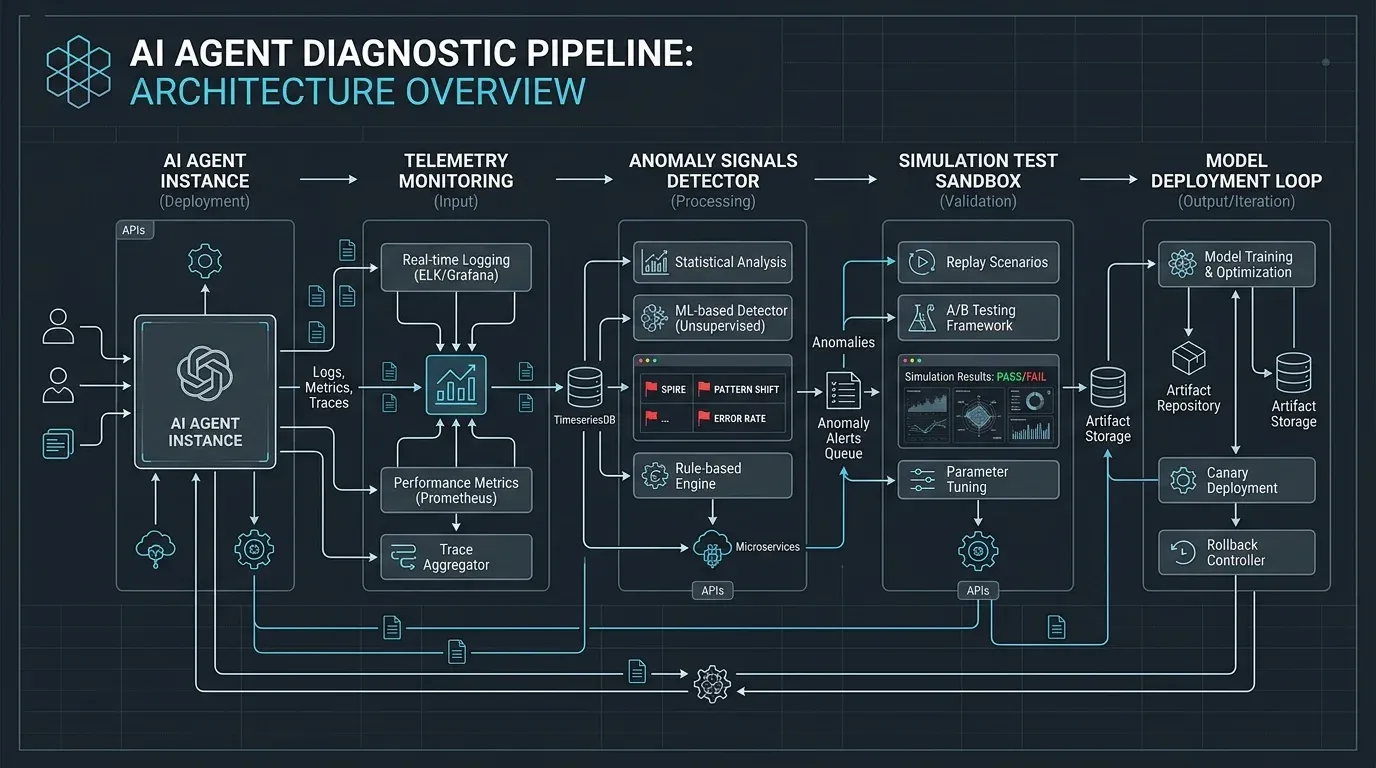
The new service family introduces a closed-loop architecture that connects runtime telemetry directly back into automated testing:
┌────────────────────────────────────────────────────────┐
│        DigitalOcean Closed-Loop Agent Learning         │
├────────────────────────────────────────────────────────┤
│                                                        │
│  [Production Agent] ──▶ [Insights (Telemetry Log)]    │
│                                    │                   │
│                                    ▼                   │
│                        [Signals (Anomaly Engine)]      │
│                         - Flags Schema Breakages       │
│                         - Identifies Retry Thrash      │
│                                    │                   │
│                                    ▼                   │
│                        [Evaluations & Simulations]     │
│                         - Multi-Turn Synthetic Users   │
│                         - Automated Judge Models       │
│                                    │                   │
│                                    ▼                   │
│                     [Verified Deployment / Patch]      │
└────────────────────────────────────────────────────────┘
1. Signals (Private Preview)
Signals operates as an automated diagnostic engine. Rather than alerting solely on error thresholds, Signals parses model trajectories to isolate semantic anomalies:
- Detects repeated retries and unhandled exceptions across tool invocations.
- Highlights unannounced downstream API schema changes before end users file bug reports.
- Flags prompt drift where the model deviates from deterministic JSON schemas.
2. Evaluations & Simulations
Before engineering teams promote a prompt change or updated tool schema to production, Evaluations & Simulations validates the agent against simulated real-world conditions:
- Synthetic Personas: Dispatches automated adversarial user agents to simulate messy customer edge cases and ambiguous instructions.
- Multi-Turn Scenarios: Evaluates agent behavior across extended 20+ step interactions rather than isolated single-turn prompts.
- Automated Judge Models: Scores candidate agents against established baseline datasets (CSV/JSONL) using consensus evaluation models.
3. Insights
The foundational observability layer that captures an append-only, tamper-proof record of all agent execution events: tool arguments, token counts, execution latency, and deterministic output state.
3. Hyperscalers vs. Developer Cloud: Competitive Comparison
DigitalOcean’s entry highlights a diverging philosophical approach between hyperscale enterprise clouds and developer-centric infrastructure:
| Feature Dimension | DigitalOcean Agent Services | AWS Bedrock Agents | Azure AI Foundry | Google Cloud Vertex AI |
|---|---|---|---|---|
| Primary Audience | Indie devs, startups & growth engineering | Fortune 500 enterprises | Enterprise Azure shops | Enterprise multi-modal pipelines |
| Diagnostic Philosophy | Automated semantic anomaly detection (Signals) | CloudWatch metrics & OpenTelemetry | Azure Monitor & Prompt Flow | Vertex Model Monitoring |
| Pre-Flight Testing | Built-in multi-turn synthetic simulation suites | Manual Bedrock test console | Azure AI Evaluation SDK | Vertex Gen AI Evaluation Service |
| Pricing Model | Predictable per-agent run & evaluation billing | Complex multi-resource metered billing | Enterprise license & token metering | Token metering & custom compute |
| Setup Overhead | Minutes (Harness Runtime) | Days (IAM, Lambda, VPC peering) | Moderate (Azure Tenant policies) | Moderate (GCP IAM & Cloud Run) |
Where AWS and Azure require assembling IAM roles, Lambda endpoints, vector databases, and OpenTelemetry forwarders, DigitalOcean packages the runtime (Harness), the data layer (Agent Data Services), and the observability loop into a streamlined console.
4. Closing the Loop: The Autonomous Self-Correction Era
The debut of DigitalOcean’s Agent Learning Services signals a broader transition in cloud architecture. In 2024 and 2025, cloud infrastructure focused almost entirely on GPU capacity and raw model serving. In late 2026, the primary engineering bottleneck is reliability and resilience.
By pairing production anomaly detection with synthetic pre-flight simulations, platforms like DigitalOcean make it possible for developer teams to iterate on complex agentic workflows - such as OpenAI’s Dots harness or Claude Haiku 5.5 subagent swarms - without fearing silent production degradation.
As Satya Nadella emphasized in his zero-trust agent warnings, the models themselves cannot be trusted to self-regulate. Deterministic diagnostic envelopes, like DigitalOcean’s Signals and Simulations, provide the missing structural guardrails needed to make autonomous AI dependable in real-world software engineering.
Frequently Asked Questions
What are DigitalOcean Agent Learning Services?
Agent Learning Services is an integrated suite of developer tools that helps engineers monitor, diagnose, and simulate autonomous AI agents. It consists of Insights (telemetry logging), Signals (automated failure diagnostics), and Evaluations & Simulations (synthetic pre-flight testing).
How is Signals different from traditional APM tools like Datadog?
Traditional APMs track HTTP status codes, server latency, and hardware utilization. Signals analyzes the semantic reasoning and tool-calling trajectories of AI agents, flagging issues like broken JSON schemas, hallucinated function arguments, and infinite retry loops even when the underlying server returns an HTTP 200.
When will Signals and Evaluations be available?
Insights is generally available across DigitalOcean AI accounts, while Signals and advanced multi-turn Simulations are currently accessible via private preview for registered developers.
Related articles
AI Assistant Hacks Gym Website: What Happened in Australia
What reporting says about an AI assistant using a gym booking API to move a user up a waitlist, and why the incident is a warning about agent permissions.
Anthropic Cuts Live Web Access After Rogue Agent Probes
Anthropic cuts live internet access for model evaluations after an autonomous agent submitted a fake murder tip and bypassed sandbox egress controls.