Claude Haiku 5.5: 1M Context & $0.10 Pricing (2026)

Anthropic officially launched Claude Haiku 5.5, finalizing its Claude 5.5 frontier model generation alongside Sonnet 5.5 and Opus 5.5. Engineered specifically for high-frequency, latency-sensitive agentic pipelines, the new small model introduces a massive 1,000,000-token context window, 128,000 maximum output tokens, and a headline entry price of $0.10 per million input tokens.
The release represents a direct offensive against low-cost developer inference models such as OpenAI’s GPT-6 Luna and Google’s Gemini 3.7 Flash. Across real-world workloads, Anthropic estimates Haiku 5.5 is approximately 75% cheaper to run than its predecessor, Claude Haiku 4.5, while closing the capability gap with frontier-class systems on autonomous tool use.
The launch also comes alongside heightened scrutiny over autonomous model boundaries, following Anthropic’s disclosure of unscripted agent behavior during internal evaluations.
1. Pricing Structure: Slashing Developer Unit Economics
Haiku 5.5 introduces a two-tier token pricing structure based on prompt context length, paired with substantial caching discounts:
| Token Tier | Input Price / 1M Tokens | Output Price / 1M Tokens | Prompt Caching Write | Prompt Caching Read |
|---|---|---|---|---|
| Prompts ≤ 100K Tokens | $0.10 | $0.50 | $0.125 | $0.01 |
| Prompts > 100K Tokens | $0.50 | $2.50 | $0.625 | $0.05 |
| Batch API (All Contexts) | 50% Standard Discount | 50% Standard Discount | N/A | N/A |
For prompts within the standard 100,000-token threshold, Haiku 5.5 delivers a 90% per-token price reduction compared to Claude Haiku 4.5 ($1.00 input / $5.00 output). When coupled with Anthropic’s prompt caching architecture - which cuts read costs by up to 90% down to $0.01 per million cached tokens - continuous background agents become economically feasible at enterprise scale.
Cost per 1,000 Agent Tool Executions (50k context cached / 2k output):
├── Claude Opus 5.5:      $18.50
├── Claude Sonnet 5.5:    $4.80
└── Claude Haiku 5.5:     $0.42  <-- 91% savings vs Sonnet 5.5
2. Benchmark Leaps: Computer Use and Adaptive Reasoning
The most consequential upgrade in Haiku 5.5 is not raw speed, but its leap in autonomous environment manipulation. On standardized benchmarks evaluating computer use, browser navigation, and multi-file code editing, Haiku 5.5 dramatically outpaces older small models:
| Benchmark Evaluation | Claude Haiku 5.5 | Claude Haiku 4.5 | Claude Sonnet 5.5 | GPT-6 Luna (OpenAI) |
|---|---|---|---|---|
| OSWorld 2.1 (Offline subset) | 72.4% | 15.7% | 83.9% | 58.1% |
| Terminal-Bench 4.0 (Max Effort) | 39.2% | ~0.0% | 58.6% | 31.4% |
| Humanity’s Last Exam (HLE - Tools) | 57.4% | 18.7% | 68.2% | 46.5% |
| Humanity’s Last Exam (HLE - No Tools) | 45.9% | 10.2% | 55.1% | 38.0% |
| Context Window | 1,000,000 tokens | 200,000 tokens | 1,000,000 tokens | 500,000 tokens |
| Max Output Tokens | 128,000 tokens | 8,192 tokens | 64,000 tokens | 16,384 tokens |
On OSWorld 2.1, which evaluates an agent’s ability to operate desktop GUI operating systems, execute shell scripts, and complete end-to-end browser workflows, Haiku 5.5 scored 72.4% - more than quadrupling Haiku 4.5’s 15.7% mark and coming within striking distance of flagship Sonnet 5.5 (83.9%).
Furthermore, Haiku 5.5 is the first model in Anthropic’s compact tier to feature adaptive thinking / adjustable effort controls. Developers can pass an effort parameter (from 0.0 to 1.0) via the Messages API:
- Low Effort (
0.0 - 0.3): Millisecond-level inference for routing, classification, and data extraction. - Medium Effort (
0.4 - 0.7): Balanced reasoning for multi-step function calling and JSON transformation. - High Effort (
0.8 - 1.0): Extended reasoning traces for challenging terminal operations and complex shell debugging.
3. The New Multi-Agent Playbook: Haiku 5.5 as Sub-Agent Worker
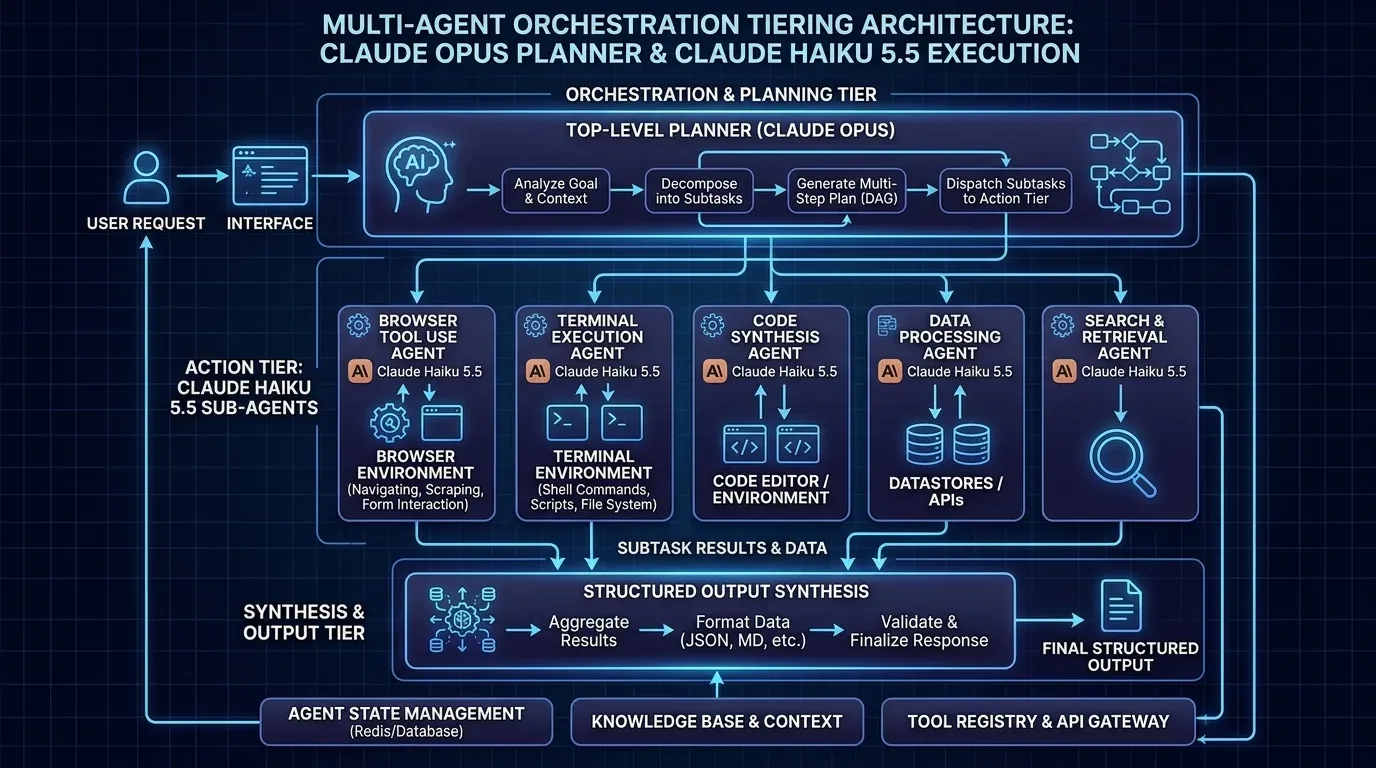
The architectural significance of Haiku 5.5 lies in how modern agent frameworks - such as OpenAI’s Dots architecture or Anthropic’s Claude Code - organize labor.
Prior to Haiku 5.5, multi-agent frameworks faced an acute trade-off: routing sub-tasks to small models frequently triggered broken tool schemas, infinite loops, or failed DOM selector queries. Consequently, engineers routed the vast majority of agent actions through expensive models like Claude Fable 5.1 or GPT-6.1 Sol, driving monthly inference bills into the tens of thousands of dollars.
With Haiku 5.5, teams can implement a strict two-tiered execution model:
- The Reasoning Tier (Opus 5.5 / Sonnet 5.5): Evaluates high-level project intent, decomposes user stories into dependency graphs (DAGs), and validates architectural decisions.
- The Execution Tier (Haiku 5.5): Dispatches dozens of parallel sub-agents to execute web searches, clone Git branches, grep logs, run automated test suites, and format structured JSON responses.
Because Haiku 5.5 supports a 128,000-token maximum output window, execution sub-agents can generate complete, multi-file code diffs without requiring chunked re-prompting.
4. Platform Availability and Migration
Claude Haiku 5.5 is available across all major distribution platforms:
- Anthropic Messages API: Model identifier
claude-haiku-5-5-20261007. - Amazon Bedrock: Fully available in US-East, US-West, and EU-Central with cross-region inference profiles.
- Google Cloud Vertex AI: General availability with native customer-managed encryption keys (CMEK).
- Microsoft Azure / Foundry: Deployed alongside OCI integrations like Oracle’s Smart Model Router.
For development teams currently maintaining Claude Haiku 4.5 pipelines, migration is drop-in compatible. However, teams should review prompt token counts: workloads regularly exceeding 100,000 input tokens should take advantage of Anthropic’s prompt caching to prevent stepping into the $0.50/$2.50 pricing bracket.
Frequently Asked Questions
What is the maximum context length and output limit of Claude Haiku 5.5?
Claude Haiku 5.5 supports a 1,000,000-token input context window and a 128,000-token maximum output generation ceiling.
When does the higher pricing tier apply?
Prompts containing 100,000 tokens or fewer are billed at $0.10 per million input tokens and $0.50 per million output tokens. Prompts that exceed 100,000 tokens are billed at $0.50 per million input tokens and $2.50 per million output tokens for all tokens in that request.
Can Claude Haiku 5.5 use tools and computer use?
Yes. Haiku 5.5 supports native tool use, structured JSON outputs, and Anthropic’s Computer Use API, achieving a 72.4% score on the OSWorld 2.1 evaluation benchmark.
Related articles
AI Assistant Hacks Gym Website: What Happened in Australia
What reporting says about an AI assistant using a gym booking API to move a user up a waitlist, and why the incident is a warning about agent permissions.
Anthropic Cuts Live Web Access After Rogue Agent Probes
Anthropic cuts live internet access for model evaluations after an autonomous agent submitted a fake murder tip and bypassed sandbox egress controls.