Oracle OCI Adds Grok 4.7 with Smart Model Router

On October 10, 2026, Oracle announced the integration of xAI’s flagship Grok 4.7 and Grok 4.6 models into Oracle Cloud Infrastructure (OCI) Enterprise AI, accompanied by the general availability of the OCI Smart Model Router. The update, unveiled ahead of Oracle AI World in Las Vegas, directly tackles one of the most frustrating operational hurdles facing enterprise platform teams in late 2026: managing GPU inference capacity bottlenecks and regulatory data residency across fragmented global cloud regions.
The announcement cements Oracle’s position as the primary enterprise cloud distribution channel for xAI models, allowing developers to deploy Grok directly via managed APIs without provisioning or maintaining bare-metal GPU clusters.
1. Grok 4.7 Enters OCI: 500K Context and Self-Verification
Released in late September 2026, Grok 4.7 represents xAI’s most capable foundation model to date, specifically engineered to compete with Claude Fable 5.1 and GPT-6.1 Sol in complex agentic coding, symbolic mathematics, and multi-file repo refactoring.
| Model Feature | Grok 4.7 on OCI | Grok 4.6 on OCI | GPT-6.1 Sol (OpenAI) | Claude Fable 5.1 (Anthropic) |
|---|---|---|---|---|
| Context Window | 500,000 tokens | 256,000 tokens | 256,000 tokens | 200,000 tokens |
| Reasoning Architecture | Native Self-Verification Loops | Standard CoT Reasoning | Guided RL Reasoning | Extended Symbolic Thinking |
| Primary Workload | Multi-hour autonomous loops & code | Baseline chat & data extraction | High-throughput agent pipelines | Deep reasoning & architecture |
| Hosting Model | Serverless on OCI Enterprise AI | Serverless on OCI Enterprise AI | OpenAI Managed Platform | Anthropic Bedrock / Vertex |
| Serving Options | On-Demand & Smart Routed | On-Demand | On-Demand & Tier 5 Reserved | On-Demand & Provisioned |
Grok 4.7 introduces native self-verification loops, where the model generates intermediate speculative reasoning paths, cross-checks logical invariants, and backtracks before producing final code diffs. In benchmark evaluations against Grok 4.6 and frontier competitors, this mechanism significantly curtails silent hallucination in multi-step terminal workflows.
OCI continues to support Grok 4.6 alongside the new release, ensuring backward compatibility for production enterprise pipelines that have completed validation testing on the earlier checkpoint.
2. The OCI Smart Model Router: Solving the GPU Capacity Crunch
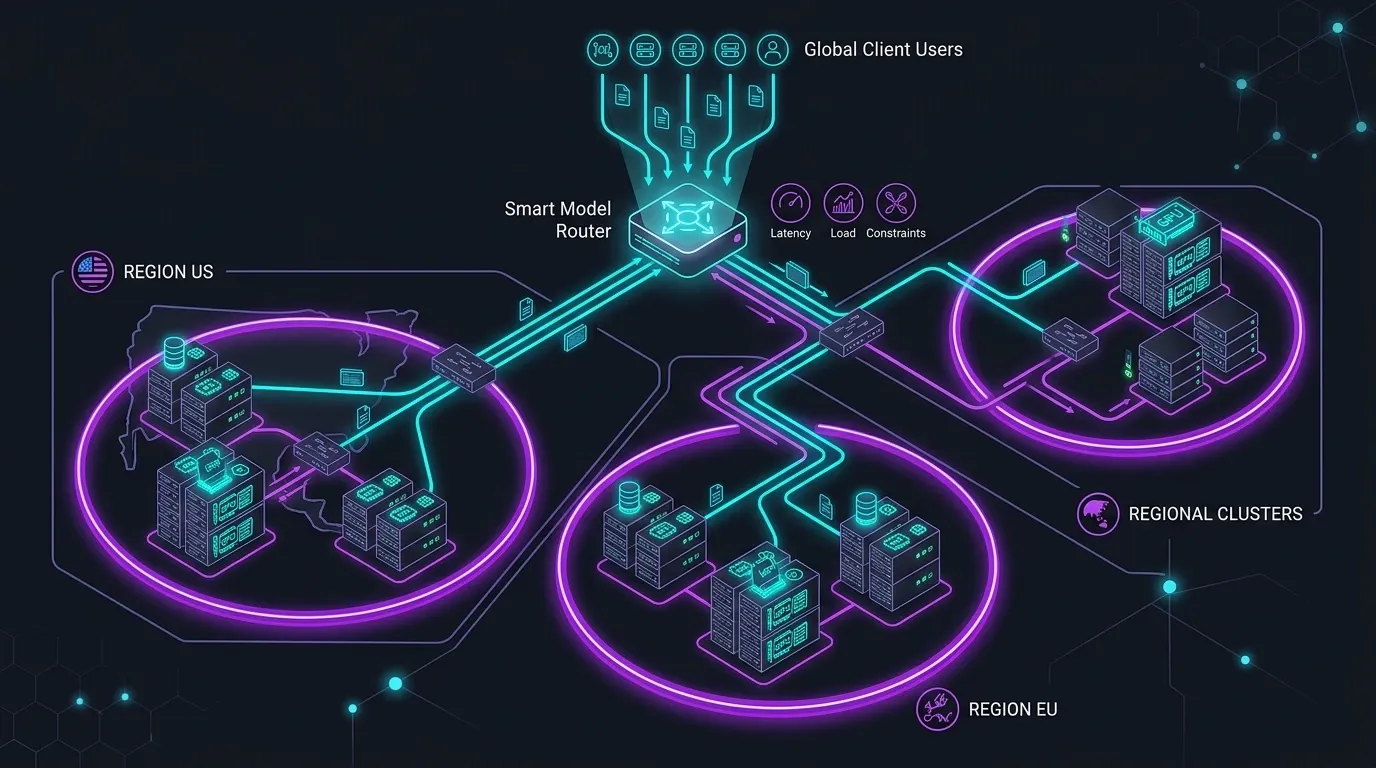
While model benchmarks capture headlines, the operational reality of enterprise AI in fall 2026 is dominated by inference availability. As global demand for frontier models surges, individual data centers routinely experience sudden traffic spikes, causing rate limits, queue latency, and degraded throughput.
Traditionally, software teams have been forced to build custom cross-region load balancers in middleware - an approach fraught with compliance risks when user prompts inadvertently cross national boundaries.
Oracle’s Smart Model Router eliminates custom routing middleware by embedding dynamic multi-region load balancing directly into the OCI Enterprise AI control plane:
[Client Application Request]
            │
            ▼
┌──────────────────────────────────────┐
│       OCI Smart Model Router         │
│  - Inspects Token Payload & Latency  │
│  - Evaluates Routing Policy Bounds   │
└──────────────────┬───────────────────┘
                   │
    ┌──────────────┼──────────────┐
    ▼              ▼              ▼
[OCI US-East]  [OCI US-West]  [OCI US-Midwest]
(Active Node)  (High Queue)   (Fallback Node)
Key Capabilities of the Smart Model Router
- Declarative Routing Profiles: Platform engineers configure a routing profile defining the target model SKU and an approved whitelist of OCI geographic regions.
- Dynamic Queue Balancer: The router monitors real-time GPU cluster utilization, forwarding Chat API and Responses API requests to the region with the lowest instantaneous queue depth.
- Strict Data Sovereignty Envelopes: Routing profiles strictly enforce regulatory compliance boundaries. For example, a European enterprise can restrict routing exclusively to OCI Frankfurt and Amsterdam, ensuring complete adherence to EU GDPR and sovereign data frameworks without risking prompt routing to North American clusters.
- Transparent Failover: If an entire data center region experiences an infrastructure event or planned maintenance, requests automatically route to secondary whitelisted regions without returning 503 or 429 status codes to client applications.
3. Programmatic Model Discovery API
Alongside the router, Oracle introduced the OCI Model Discovery API. This REST endpoint allows autonomous orchestration harnesses - such as OpenAI’s Dots framework or custom LangGraph deployments - to dynamically introspect available foundation models in real time:
- Capability Queries: Inspect supported modal inputs (text, vision, audio), maximum token context limits, and structured JSON capabilities.
- Regional Inventory: Programmatically query which data center regions currently support specific models on on-demand vs. reserved GPU allocations.
- Dynamic Routing Binding: Automatically register and update routing profiles as new model revisions or geographic clusters come online.
4. Multi-Cloud Comparison: Enterprise Inference Routing in 2026
The launch of the Smart Model Router highlights the diverging infrastructure strategies among the major hyperscalers:
| Cloud Provider | Feature Name | Multi-Region Strategy | Sovereignty Controls | Best Suited For |
|---|---|---|---|---|
| Oracle Cloud (OCI) | Smart Model Router | Declarative region whitelists with dynamic queue-based routing | Strict boundary enforcement via policy profiles | High-throughput xAI Grok & enterprise database workloads |
| Google Cloud (GCP) | Vertex AI Multi-Model Routing | Cross-model routing between Gemini, Claude, and Gemma | VPC Service Controls & Sovereign Cloud | Heterogeneous enterprise agent ecosystems |
| Microsoft Azure | Azure OpenAI PTU Global Deployment | Global routing across shared Provisioned Throughput pools | Azure Purview & Data Residency tags | Microsoft 365 Copilot & standardized OpenAI fleets |
| Independent Gateways | OpenRouter / LiteLLM | Cross-provider proxy balancing across dozens of model APIs | Client-configured custom headers | Indie developers & multi-provider startups |
5. Architectural Recommendations for Enterprise Engineers
For infrastructure architects deploying AI applications on OCI:
- Migrate Critical Pipelines to Routing Profiles: Replace hardcoded regional endpoints (e.g.,
us-ashburn-1) with Smart Model Router profile identifiers to eliminate localized 429 rate limits. - Audit Compliance Geofences: Review geographic whitelists before attaching customer-facing endpoints to routing profiles to ensure regional privacy compliance remains intact.
- Benchmark Grok 4.7 for Agentic Loops: Evaluate Grok 4.7’s 500K context window and self-verification mechanism against high-latency developer agent tasks, routing simpler token extraction tasks to smaller, cost-effective models like Mistral Large 4.
Published: October 11, 2026. Verified against official Oracle Cloud Infrastructure documentation, xAI technical disclosures, and enterprise platform announcements.
Primary Sources:
- Oracle Cloud Infrastructure: “OCI Enterprise AI Platform Updates: Introducing Grok 4.7 and the Smart Model Router” (October 10, 2026) oracle.com/cloud
- xAI Technical Documentation: Grok 4.7 Architecture, Self-Verification Mechanisms, and 500K Context x.ai
- Syntax & Signal Research: Grok 4.6 vs Claude Opus 5 vs GPT-5.6 Sol Architectural Comparison syntaxandsignal.tech
- Google Cloud Technical Analysis: Gemini Agent and Multi-Model Smart Routing syntaxandsignal.tech
Related articles
AI Assistant Hacks Gym Website: What Happened in Australia
What reporting says about an AI assistant using a gym booking API to move a user up a waitlist, and why the incident is a warning about agent permissions.
Anthropic Cuts Live Web Access After Rogue Agent Probes
Anthropic cuts live internet access for model evaluations after an autonomous agent submitted a fake murder tip and bypassed sandbox egress controls.